9 Best Workbench Legs and Frames for DIY Benches (November 2026)
The best Workbench Legs and Frames for DIY Benches include the FLEXIMOUNTS Workbench Legs Kit for full-size benches, the FLEXIMOUNTS Workbench Legs Kit With Shelf for lower storage, and the Kreg Standard-Height Workbench Leg Set for Kreg rail builds.
On this page (7 sections)
- How should you choose workbench legs?
- The best workbench legs and frames for DIY benches
- What measurements matter before you buy workbench legs?
- How do you set up DIY workbench legs?
- What common workbench leg mistakes should you avoid?
- Are leg kits better than a full workbench?
- Which workbench legs should you choose?
The FLEXIMOUNTS Workbench Legs Kit is the best workbench legs choice for a full-size DIY bench, with a steel frame for a top up to 96 x 48 in. Choose Kreg for adjustable height, OLBRUS for outlets in a compact base, or GOOCORREC brackets if you want to build the frame around 2x4 lumber.
Workbench legs affect more than the bench height. Their footprint determines how much top they support, what you can store underneath, and whether the whole setup fits the garage or shop.
A DIY build gives you control over the top material, dimensions and layout. It also means you need to plan the lumber, fasteners, tools and finished height before assembly.
For help choosing the surface, see our guide to plywood vs MDF for a workbench top. If you're deciding between a kit and a complete bench, read workbench kit or ready-made workbench.
Our picks at a glance
-
1

-
2

-
3

- 4
 Check it
OLBRUS 19.6 in Depth Workbench Frame
Best for compact work areas - 5
 Check it
FLEXIMOUNTS L-Shaped Steel Workbench Kit
Best for corner layouts - 6
 Check it
OLBRUS Workbench Frame With Lockable Wheels
Best for mobile benches - 7
 Check it
Heavy Duty Workbench Bracket Kit
Best for 2x4 frame builds - 8
 Check it
Montezuma Adjustable Workbench Legs
Best for uneven floors - 9
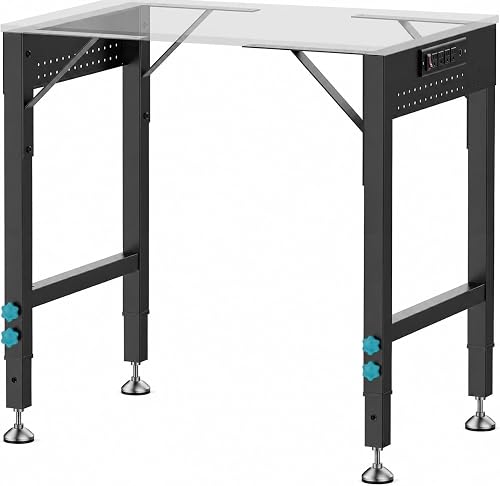 Check it
Seesii Heavy Duty DIY Workbench Frame
Best for low work surfaces
How should you choose workbench legs?
Choose workbench legs by starting with your top dimensions, then matching the frame height and features to your work. The right fit gives the top support where it needs it and keeps the finished surface comfortable to use.
We compared frame materials, height ranges, size guidance and included parts. Our picks serve different builds, from a wide fixed-height bench to a compact base with outlets or a frame made from dimensional lumber.
| Product | Best for | Top size | Height | Material | Our score |
|---|---|---|---|---|---|
| FLEXIMOUNTS Workbench Legs Kit | full-size benches | Up to 96 x 48 in | 35.4 in | Steel | 8.7 |
| FLEXIMOUNTS Workbench Legs Kit With Shelf | lower storage | Up to 96 x 48 in | 35.4 in | Steel | 8.4 |
| Kreg Standard-Height Workbench Leg Set | Kreg rail builds | 31 to 39 in | 12-gauge steel | 8.3 | |
| OLBRUS 19.6 in Depth Workbench Frame | compact work areas | 28.5 to 33.8 in | 8.2 | ||
| FLEXIMOUNTS L-Shaped Steel Workbench Kit | corner layouts | Steel | 8.0 | ||
| OLBRUS Workbench Frame With Lockable Wheels | mobile benches | 28.5 to 33.8 in | 7.9 | ||
| Heavy Duty Workbench Bracket Kit | 2x4 frame builds | Steel | 7.8 | ||
| Montezuma Adjustable Workbench Legs | uneven floors | Adjusts from 29 in | 18-gauge steel | 7.6 | |
| Seesii Heavy Duty DIY Workbench Frame | low work surfaces | 25.6 to 35.4 in | 7.4 |
The best workbench legs and frames for DIY benches
The best frame depends on whether you need a large top, adjustable height, shelves, mobility or a custom lumber structure. Decide what the bench must do before choosing extras.
FLEXIMOUNTS Workbench Legs Kit: Best for full-size benches
- Steel legs and mounting hardware
- For tops up to 96 x 48 in
- 35.4 in height
- Lumber not included
A steel leg kit with hardware for building a custom workbench. FLEXIMOUNTS gives a maximum top size of 96 x 48 in, and you supply the lumber.
Pros
- Large maximum top size
- Includes mounting hardware and screws
- Steel construction
Cons
- Lumber not included
- Height is 35.4 in
The FLEXIMOUNTS Workbench Legs Kit is the strongest general pick for a full-size DIY bench. Its steel legs and included mounting hardware support a build up to 96 in long and 48 in wide, with a height of 35.4 in.
The kit includes screws, fixing covers and plates, plus an instruction guide. You supply the lumber, so choose the top and any lower shelf boards before assembly.
This fixed-height setup suits a garage where the work surface can stay at one level. If you plan a smaller bench, use the maximum size as a limit, not as a required cut size.
Choose it when you want a broad custom bench and have a lumber plan. Skip it if you need the height to adjust or want a ready-made top in the box.
FLEXIMOUNTS Workbench Legs Kit With Shelf: Best for lower storage
- Steel leg kit with shelf option
- For tops up to 96 x 48 in
- Lumber not included
This FLEXIMOUNTS kit adds shelf support to a custom bench build. It uses a steel frame and leaves the top and shelf lumber to you.
Pros
- Shelf option
- Large maximum top size
- Includes screws and mounting hardware
Cons
- Lumber not included
- Height adjustment details need confirmation
This FLEXIMOUNTS version is a better match when you want shelf support built into the frame plan. Like the standard kit, it accepts a custom top up to 96 x 48 in and includes mounting hardware and screws.
The shelf adds a place for supplies below the main work surface, but you need to choose and cut lumber for both levels. Check where the shelf will sit against the items you want to store and leave room for anything that must pass below the bench.
Its stated height is 35.4 in, so include the top thickness when calculating the finished surface height. Choose this model if a lower shelf is useful; skip it if you want a simple top-only build.
Kreg Standard-Height Workbench Leg Set: Best for Kreg rail builds
- Set of 4 steel legs
- 31 to 39 in height range
- Pre-drilled mounting holes
Kreg's four-leg set suits a custom bench where a height range matters. The legs have pre-drilled mounting holes and can pair with Kreg Universal Bench Rails.
Pros
- 31 to 39 in height range
- Pre-drilled mounting holes
- Compatible with Kreg Universal Bench Rails
Cons
- Rails and top are separate parts
Kreg's four-leg set fits a custom bench where you want to choose the working height within a range. The legs adjust from 31 to 39 in, and pre-drilled holes simplify mounting to a custom benchtop.
Kreg says these legs can combine with its Universal Bench Rails to make a custom workbench. The rails and top are separate parts, so confirm the full frame plan before cutting or drilling.
This set suits builders who want adjustability or already plan to use Kreg's rail system. Skip it if you want one complete frame kit with the top and rails included.
OLBRUS 19.6 in Depth Workbench Frame: Best for compact work areas
- 19.6 in square frame depth
- Height adjusts from 28.5 to 33.8 in
- 4 AC outlets and 2 USB-A ports
This compact OLBRUS frame combines adjustable height with built-in outlets. Its 19.6 in depth can suit a narrower top, but check that it fits your planned bench dimensions.
Pros
- Adjustable height
- Built-in AC outlets and USB-A ports
- Adjustable foot pads
Cons
- Shallower frame than a full-depth bench
- Top not included
The OLBRUS frame suits a narrow work area where adjustable height and nearby power access matter. It has a 19.6 in square depth and adjusts from 28.5 to 33.8 in.
Four AC outlets and 2 USB-A ports are built into the frame. Adjustable foot pads help level the base and protect the floor, while connectors add support between frame parts.
Measure the depth of your tools and workpieces before settling on a shallow top. Choose this OLBRUS if you want compact dimensions and outlets; skip it if you need a broad woodworking surface.
FLEXIMOUNTS L-Shaped Steel Workbench Kit: Best for corner layouts
- Steel kit with 5 legs and shelf brackets
- For builds up to 8 ft long
- Lumber not included
A five-leg steel kit designed for an L-shaped workbench build. It includes shelf brackets and hardware, while you provide the lumber.
Pros
- L-shaped layout
- Five legs and shelf brackets
- Includes screws and mounting hardware
Cons
- Lumber not included
- Plan the corner footprint before cutting
The FLEXIMOUNTS L-shaped kit fits a corner work area where a straight bench would leave space unused. It includes 5 steel legs, shelf brackets and hardware for a build up to 8 ft long.
An L layout provides working area across two directions, but it needs a careful footprint plan. Measure both runs, account for the corner, and leave room for doors, drawers and walking paths before cutting lumber.
The kit does not include the top or shelf boards. Choose it for a corner-based build with shelf support in the plan; skip it if your available space only fits a straight bench.
For more guidance on whether the footprint makes sense, see our guide to an L-shaped workbench.
OLBRUS Workbench Frame With Lockable Wheels: Best for mobile benches
- Lockable wheels with brakes
- Height adjusts from 28.5 to 33.8 in
- 4 AC outlets and 2 USB-A ports
This OLBRUS base adds wheels with brakes to an adjustable frame. It suits a bench that needs to move around the workshop, with the brakes set before work.
Pros
- Wheels have brakes
- Adjustable height
- Built-in outlets and USB-A ports
Cons
- Top not included
- Confirm the assembled footprint for your top
The OLBRUS frame with lockable wheels suits a custom bench that needs to move around the shop. Its height adjusts from 28.5 to 33.8 in, and the wheels have brakes.
The base also includes 4 AC outlets and 2 USB-A ports. Set the brakes before work, and consider how the top size affects turning and moving the assembled bench through doorways or between tools.
Its 19.6 in depth suits a compact bench better than a broad woodworking surface. Choose it when mobility matters; skip it if the bench will stay fixed and you want a deeper base.
Heavy Duty Workbench Bracket Kit: Best for 2x4 frame builds
- 8 steel brackets and 64 screws
- Fits 2x4 lumber with actual 1.5 x 3.5 in dimensions
- Pre-drilled holes
These three-way brackets make a lumber-first build possible with common 2x4 framing. Check the actual lumber dimensions before assembling the frame.
Pros
- Eight brackets in the kit
- Includes 64 screws
- Pre-drilled holes
Cons
- Requires a separate lumber plan
- Confirm lumber dimensions before buying
The GOOCORREC bracket kit suits a frame built from 2x4 lumber. It includes 8 pre-drilled steel brackets and 64 screws, sized for lumber with actual dimensions of 1.5 x 3.5 in.
This approach gives you control over the frame length and lower supports, but the lumber plan is yours. Confirm the actual board dimensions before ordering, since nominal 2x4 labels don't describe the measured size.
Plan the frame square and level, then position the supports so the top spans them without a long unsupported edge. Choose these brackets if you want a lumber-first project; skip them if you prefer a ready-designed metal base.
Montezuma Adjustable Workbench Legs: Best for uneven floors
- 18-gauge steel frame
- Adjustable height from 29 in
- Threaded leveling feet
Montezuma's steel base includes threaded feet for leveling on an uneven floor. Add your own top, and check the frame dimensions against your planned bench.
Pros
- Threaded leveling feet
- Diagonal braces
- Top material is your choice
Cons
- Top not included
- Published dimensions need checking against your layout
Montezuma's adjustable workbench legs are a good fit for a garage floor that isn't level. Threaded feet let you level each corner, and the steel base adjusts from 29 in.
The frame has a 41 in-wide top area, welded corner brackets and diagonal braces. It ships as a base, leaving you to choose the top material and match its dimensions to the frame.
Check the full footprint and height against your preferred setup before buying. Choose Montezuma for leveling feet and an open area underneath; skip it if you need a clearly stated wide height range or built-in outlets.
Seesii Heavy Duty DIY Workbench Frame: Best for low work surfaces
- Height adjusts from 25.6 to 35.4 in
- 20.8 in depth
- 4 AC outlets and 2 USB-A ports
Seesii offers a broad height range and a 20.8 in-deep frame for a custom top. The frame includes mounting hardware, an Allen wrench and 6 metal hooks.
Pros
- Wide stated height range
- Built-in power strip
- Includes 6 metal hooks
Cons
- Top not included
- Electric drill required for assembly
The Seesii frame suits a custom bench that needs a low working height or a broad adjustment range. It adjusts from 25.6 to 35.4 in and has a 20.8 in depth.
Its built-in power strip has 4 AC outlets and 2 USB-A ports. The frame also comes with mounting hardware, an Allen wrench and 6 metal hooks, though assembly requires an electric drill.
The tabletop is not included, so measure the work area and choose a top that fits. Seesii states a 2,000 lb support capacity; the complete bench still depends on the top, assembly and load placement.
Choose it if you need a low minimum height and value hooks and outlets. Skip it if you need a large top, since the stated frame depth is compact.
What measurements matter before you buy workbench legs?
Measure the space, planned top and finished working height before ordering. A frame can be strong and still be the wrong choice if its footprint, height or support points don't fit your build.
Start by marking the bench footprint on the floor with tape. Include room to walk around it, open nearby doors and reach storage, then measure the top you intend to use.
How wide and deep should the frame be?
The top should fit your space and projects, with support under its edges and across its span. Compact frames around 20 in deep can work for a utility station, while a large woodworking top needs a support plan that matches its dimensions.
Don't assume a frame's maximum top size is the only size it can support or the exact lumber size you should cut. Use the frame instructions and mounting points to plan the top, overhang and any shelf.
For plywood surfaces, thickness and support spacing affect stiffness. Our guide to workbench top thickness covers the main sizing questions.
What bench height should you choose?
Set the height by how you work and whether you stand, sit or alternate between tasks. Measure from the floor to the intended top surface, and include the top's thickness when comparing that result with a frame's height range.
A low work surface may suit seated work or tasks that need a lower reach. A taller bench can be more comfortable for some standing tasks, but the right height depends on your posture and the work itself.
If the height is already right and won't change, a fixed frame can simplify the choice. If multiple people use the bench or you want to change positions, compare adjustable ranges and how easy the frame is to level.
Do you need leveling feet or wheels?
Leveling feet help stabilize a bench on an uneven floor, while wheels let you move it when the work area changes. These solve different problems: feet are for a stationary setup, and wheels are for planned movement.
If you choose wheels, consider the route and clearance before attaching the top. A wide bench may be difficult to turn in a crowded garage, and brakes should be set before work begins.
How do you set up DIY workbench legs?
Set up the frame on a level surface, confirm the lumber and top dimensions, then assemble according to the included instructions. Check the frame for square and stability before loading it with tools.
Lay out the legs or brackets and identify the top and shelf boards before drilling. Mark the screw locations, confirm the fasteners suit the lumber, and avoid placing a screw where it could split an edge.
For bracket kits, verify the lumber's actual dimensions first. Clamp or brace the frame while assembling so the joints stay aligned, then recheck that the base sits flat before adding the top.
For adjustable bases, set all corners to the planned height and level the feet before attaching the top. On a wheeled frame, test the brakes and movement path with the bench empty.
What common workbench leg mistakes should you avoid?
The most common mistakes are choosing by capacity alone, forgetting the top thickness and ordering lumber before confirming the frame dimensions. A careful measurement and assembly plan prevents expensive rework.
A capacity figure applies to a complete setup under particular conditions. The top, fasteners, support spacing, floor and load placement all affect how a custom bench behaves, so distribute heavy items and follow the frame instructions.
Avoid a top with a long unsupported overhang unless the frame design allows it. Also plan shelf clearance before assembly, since a lower board can block bins, stools or equipment you expected to store underneath.
Don't treat nominal lumber sizes as actual measurements. This matters especially for the GOOCORREC bracket kit, which is designed around 2x4 boards measuring 1.5 x 3.5 in.
Are leg kits better than a full workbench?
A leg kit makes sense when you want to choose the top size and material yourself. A ready-made bench can save planning time when its dimensions and features already fit your space.
Before choosing a kit, account for the lumber, cutting tools, fasteners and assembly time. You may also need to finish the top or source shelf boards separately.
Our guide to workbench kits versus ready-made benches walks through that decision. If the top material is still undecided, compare wood top workbenches and our plywood versus MDF guide.
Which workbench legs should you choose?
Choose the FLEXIMOUNTS Workbench Legs Kit for a large fixed-height bench, Kreg for an adjustable build using its rail system, and GOOCORREC brackets for a frame made from 2x4 lumber. Pick OLBRUS for a compact base with outlets, its wheel version for mobility, or Seesii when a lower height range matters.
If your work area has a corner to use, the FLEXIMOUNTS L-shaped kit adds a shelf-support option. For uneven floors, Montezuma's threaded feet are the clearest fit.
Before buying, match the frame to your top dimensions, finished height and available floor space. Then compare wood top workbenches if you want a ready-made surface instead of sourcing lumber.
Our top 3 picks at a glance
-
1
-
2
-
3
Frequently asked questions
How do I choose workbench legs for a DIY bench?
Choose workbench legs by matching the frame to your top size and preferred working height. Consider your expected use, check whether the kit includes mounting hardware, shelf supports or leveling feet, and confirm which lumber or top parts you need to supply.
Measure the work area before committing to a wide or corner layout.
Are adjustable workbench legs worth it?
Adjustable workbench legs help when you need to set the surface for seated or standing work, or level the bench on an uneven floor. Compare the full height range with your preferred working height, including the thickness of your top.
If the bench will stay at one height, a fixed frame may be simpler.
Do workbench leg kits include the wood top?
Many DIY leg kits are frames only, so you need to buy or cut the top lumber separately. The FLEXIMOUNTS kits and Seesii frame here exclude the tabletop, and the shelf version also needs shelf boards.
Plan the lumber and any needed cutting before assembly.
How much weight can workbench legs support?
Capacity depends on the assembled bench, including its frame, top, fasteners, floor and load placement. Some frames state a maximum capacity, but that number does not cover every custom combination of lumber and assembly.
Follow the frame instructions and spread heavy items across the supported area.


