How to Choose a Heavy-Duty Workbench
To choose a heavy-duty workbench, match the load rating to your heaviest project first, then pick the frame, surface, storage and mobility that fit your shop. A 1,000 lb bench covers most woodworking and repair work, while a 2,200 lb steel bench suits power tools and engine work.
On this page (10 sections)
- How much weight should your heavy-duty workbench carry?
- Which frame material holds up in a working shop?
- What surface material should the workbench top be?
- How do storage and accessories change the choice?
- When should you choose a rolling workbench?
- How much space does a heavy-duty workbench need?
- Does an adjustable or folding workbench fit your shop?
- Which heavy-duty workbench fits each kind of buyer?
- What should you check before you buy a heavy-duty workbench?
- The bottom line on how to choose a heavy-duty workbench
To choose a heavy-duty workbench, start with the load rating, then work through the frame, surface, storage and mobility in that order. Every other decision follows from how much weight and abuse the bench has to take.
A workbench is the one surface in your shop that gets hammered, clamped and loaded without mercy. Buying on looks or price alone often ends with a top that sags or a frame that racks sideways under a vise.
This guide walks through each decision in the order that matters. By the end you'll know which bench type fits your projects and where to spend the money.
How much weight should your heavy-duty workbench carry?
Size the load rating around your heaviest realistic project, doubled for safety. A bench that only just holds your current gear will flex and loosen over time.
Workbenches are rated by static load, the weight the top holds while sitting still. A 1,000 lb rating means the bench can support that much on the top without failing, but it says nothing about how the bench behaves when you push, plane or pound on it.
Use these bands to pick a starting rating.
| Rating | Suits | Watch for |
|---|---|---|
| Under 500 lb | Light craft, electronics, small repairs | Flex under a vise or hand plane |
| 1,000 lb | General woodworking, assembly, home repairs | Frame stiffness matters more than the number |
| 2,000 lb and up | Power tools, engine parts, dense lumber | Weight and footprint grow with the rating |
How to estimate the load you really need
Add up the tool or project weight, then add the downward force of clamping or hand-planing. A vise tightened on a board can push hundreds of pounds into the top and frame.
Then double it. The margin covers dynamic loads from hammering, dropping a motor or leaning your body weight on the edge.
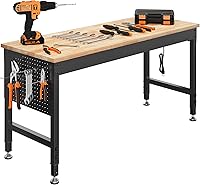
The lower shelf on a two-tier bench carries its own separate rating. On the Northsky 48 in bench the main top holds 2,200 lb while the lower shelf is rated to 500 lb, so stack the heavy motor on top and keep toolboxes on the shelf below.
That split matters when you plan where the weight goes.
Pick a 1,000 lb bench for most home projects and step up to 2,000 lb or more when heavy power tools or engine work are routine.
Which frame material holds up in a working shop?
Steel frames carry the most weight and stay stiff, while aluminum legs save weight and resist rust. Choose steel for a fixed heavy bench and aluminum for a bench you fold or move.
A frame's job is to stop the top from racking, twisting and sagging. Square steel tube with welded or bolted joints does that best.
Aluminum is lighter and won't rust, which matters in a damp garage.
- Steel: highest stiffness and load ratings, needs paint or powder coat to resist rust.
- Aluminum: light and rust-proof, good for folding and portable benches, less rigid at long spans.
- Resin and plastic: weather-resistant and cheap, fine for light duty only.
Check how the legs join the top and how the frame braces against side-to-side movement. A diagonal brace or a lower shelf that ties the legs together makes a bench feel far more solid than leg thickness alone suggests.
On a kit frame you supply that bracing yourself, so plan for a shelf or a back rail when you cut the lumber.
Pick a steel frame when the bench stays put and takes heavy loads, and aluminum when it has to fold or travel.
What surface material should the workbench top be?
The top takes the most abuse, so match the surface to what you'll do on it. Wood and engineered wood absorb impact and hold clamps well; metal tops shrug off solvents and heavy sliding loads.
Wood tops are the traditional choice for woodworking because they grip a vise, take a hammer blow and can be sanded flat again. Engineered wood is flatter and cheaper but dislikes standing water.
Steel tops suit welding, mechanics and oily work.
Thickness matters as much as material. A 1-inch engineered wood top resists sagging far better than a thin panel.
Look for a top that overhangs the frame slightly so you can clamp to the edge. The Northsky top measures 48 by 23.6 in and is an inch thick, which is why it holds a 2,200 lb rating without a steel skin.
For buyers who want to pick their own lumber and finish, a frame kit is the flexible route. The {{product B08XMJ2Q8F | A steel leg kit that lets you build a bench up to 96 in long and 48 in wide with your own lumber top.}} carries up to 1,000 lb per shelf once assembled.
Choose a thick wood or engineered wood top for clamping and impact, and a metal top for solvents, welding and sliding heavy parts.
How do storage and accessories change the choice?
Storage decides whether the bench stays usable or becomes a pile. Plan shelves and hangers before you buy, because adding them later often means a sturdier frame than you first picked.
A lower shelf holds toolboxes and bulky equipment and also braces the legs. A rear shelf or pegboard keeps hand tools off the top and within reach.
Drawers suit small parts but add cost and weight.
Power is the other big accessory. A built-in outlet strip saves running an extension cord across the floor every time you charge a drill or plug in a work light.
The Northsky bench builds this in with a 1,500W power strip carrying four AC outlets, one USB-A and one USB-C port on a 6.5 ft cord. That strip is ETL certified, so it arrives ready to plug in rather than needing a separate unit screwed to the frame.
Weigh storage against work room. A bench crowded with shelves leaves less clear top for the project itself.
Measure your longest tool and your tallest toolbox before committing.
Buy the storage you'll actually fill and skip the rest; a clear top matters more than a full wall of shelves.
When should you choose a rolling workbench?
Pick wheels when the bench needs to move between jobs or tuck away in a shared garage. A rolling bench shines in a small shop where the same table serves as a workbench, assembly table and outfeed support.
The trade-off is stability. A bench on casters can creep when you plane or push against it unless the casters lock.
Fixed legs sit flat and stay put under side load.
If you want both, look for a bench with optional casters so you can fit them only when needed. That way the bench sits solid for heavy work and rolls for cleanup or rearranging.
Leveling feet handle a floor that slopes, and swapping to casters turns the same frame into a mobile station.
For a fuller comparison of mobile options, our guide to the workbench with wheels covers what to check in the casters and frame. The {{product B0GCD8V5MG | A 48 in steel bench rated to 2,200 lb with optional casters included for mobile use.}} pairs a heavy rating with the choice to roll.
Choose wheels for a shop that changes shape; choose fixed legs for planing, pounding and vise work that needs a solid base.
How much space does a heavy-duty workbench need?
Measure the floor footprint plus working room on every side. A bench that fits the wall but blocks a door or a car is the wrong bench.
Width drives the decision more than anything. A 48 in bench fits a one-car bay; a 60 in bench gives more top for long boards and two projects.
Depth usually runs 22 to 24 in, enough for a vise and a tool tray without crowding the walkway.
Leave clear space in front to stand and swing a hammer, and room at the ends for long stock. If the bench sits against a wall, keep the wall outlets reachable or plan for a power strip on the bench itself.
A kit frame changes this math because you set the size, with a maximum of 96 in long by 48 in wide and a fixed 35.4 in height.
Height is the other space question. A fixed bench around 35 in suits standing work for most people.
An adjustable frame lets you raise or lower the top to match the task or the person using it. The Northsky legs run from 27.9 to 43.4 in, so the same footprint covers seated electronics work and standing saw work.
For longer tops and more clear work area, see our roundup of the 60 inch workbench options and what fits in a typical garage.
Measure width, depth, standing room and height before buying, and leave a clear walkway in front of the bench.
Does an adjustable or folding workbench fit your shop?
An adjustable bench changes height; a folding bench collapses for storage. Choose adjustable when the task or user changes, and folding when the bench has to disappear between jobs.
An adjustable workbench raises and lowers its top so you can saw at one height and assemble at another. That flexibility matters in a shop shared by two people of different heights or used for both standing and seated work.
Our explainer on how an adjustable workbench works covers the mechanisms and what to check.
A folding bench sets up in seconds and stores flat against a wall. It suits renters, small garages and anyone who needs a bench only now and then.
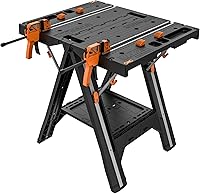
The trade-off is usually a lower load rating and less room for a permanent vise. On the Keter folding bench the top opens in about 30 seconds with no assembly, and the 12 in clamps install horizontally or vertically to hold stock on either face.
Think about how often you'll actually clear the bench. A folding design only helps if you'll fold it.
Otherwise a fixed or rolling bench gives you more stiffness for the same money.
Pick adjustable for changing heights and shared users, and folding for a bench that must store flat.
Which heavy-duty workbench fits each kind of buyer?
Match the bench to the work you do most, not to the biggest project you can imagine. The right bench is the one whose rating, surface and footprint fit your routine.
Folding bench for a garage that doubles as parking
The {{product B001CWX26Y | A 1,000 lb folding bench that sets up in 30 seconds and stores flat.}} suits a home garage where the car needs the floor most days. Its polypropylene top and aluminum legs won't rust, so it handles a damp garage without worry.
At 27 lb it is light enough for one person to carry to the driveway.
The built-in 12 in clamps hold work in place, and the top takes a miter saw or hand tools. The working surface sits 33.46 in wide by 21.65 in deep at 29.75 in high, close to the 35 in rule but a little lower for seated or smaller users.
It carries up to 1,000 lb while open and folds away for storage. That makes it a good fit for occasional woodworking and home repairs rather than a permanent shop.
Rolling steel bench for a working garage
The {{product B0GCD8V5MG | A 2,200 lb steel bench with a power strip and pegboards for a busy shop.}} is the pick for buyers who want a permanent workhorse that can still move. Its 1 in engineered wood top spans 48 by 23.6 in and the steel frame carries the heavier rating.
At 79 lb it is a two-person lift to set up.
The integrated power strip adds four AC outlets and USB ports, and the dual pegboards keep tools off the top. The kit includes five long hooks and six short hooks for screwdrivers, wrenches and drills.
Optional casters let it roll when you need the space. This bench fits woodworking, repairs and assembly in one spot.
Frame kit for a custom woodworking bench
The {{product B08XMJ2Q8F | A steel leg kit for building your own bench up to 96 in long.}} suits buyers who want a lumber top in their chosen size and finish. You supply the wood and the kit supplies the steel legs and hardware.
At 20 lb the kit itself is light; the lumber is what adds the weight and the stability.
It assembles up to 96 in long, 48 in wide and 35.4 in high, with a 1,000 lb rating per shelf. The kit includes the legs with pre-drilled screw holes, hardware covers and plates, screws and instructions.
You can stain or paint the top to match your shop. For a woodworker who wants a bench built to fit a wall, this is the flexible route.
Our guide to the folding workbench covers storage-friendly designs in more depth if floor space is your main constraint.
Pick the folding bench for shared floor space, the rolling steel bench for a permanent heavy shop, and the frame kit for a custom lumber top.
What should you check before you buy a heavy-duty workbench?
Run a short checklist before you commit. The rating, the frame joints, the top thickness and the footprint decide whether the bench holds up.
Check the load rating against your heaviest project with margin to spare. Confirm the top material and thickness suit your work.
Look at how the legs join the frame and whether bracing stops side-to-side movement. Measure the footprint and the walkway in front.
Decide on storage and power now rather than later. A lower shelf braces the frame and holds gear; a power strip saves cords across the floor.
Think about height and whether it needs to change. The Keter and Northsky benches each carry a one-year warranty, so the checklist is also your protection against a bench that does not suit.
Finally, decide on mobility. Locking casters suit a shop that rearranges; fixed legs suit steady vise and plane work.
If the bench must store flat, choose a folding design.
Write down your rating, top, storage and mobility needs, then buy the bench that meets all four without overspending on capacity you'll never use.
The bottom line on how to choose a heavy-duty workbench
The best heavy-duty workbench for most home shops is one rated around 1,000 lb with a wood or engineered wood top and room for a vise. Step up to a 2,000 lb steel bench when power tools and engine work are routine.
Decide capacity first, then frame and surface, then storage and mobility. A bench that fits your projects and your floor will outlast a bigger one that gets in the way.
For a custom build with your own lumber top, start with the FLEXIMOUNTS Workbench Legs Kit and size the top to your wall. If you want a heavy rolling bench out of the box, compare the options in our workbench with wheels guide.
Frequently asked questions
Is a wooden or metal workbench better?
Metal frames carry more weight and resist warping in damp shops. Wood or engineered wood tops are kinder to tools and easier to drill or clamp into.
A steel frame kit with a lumber top lets you choose both.
Do I need a workbench with wheels?
Wheels pay off in a small shop where the bench doubles as an assembly table and needs to roll out of the way. A fixed bench is more stable for planing, sawing and heavy pounding, so choose wheels only if mobility matters more than absolute rigidity.
How tall should a workbench be?
Set the top at about wrist height when you stand relaxed with your arms at your sides. That usually lands near 34 to 36 inches for general work, though detailed assembly and tall tools push the number higher, which is why an adjustable bench helps.
What is the best workbench depth for a garage?
A depth of 22 to 24 inches fits most garage walls while leaving room to walk past. Go deeper only when you need space for a miter saw or large projects, and measure your floor first so the bench does not block a door or parked car.