Metal Workbench Buying Guide: Steel and Finish
Choose a metal workbench by its frame, rated load, top, finish and storage. Match those details to your tools and tasks, then measure the work area and route into the garage.
On this page (9 sections)
- What should you check when buying a metal workbench?
- Does steel type matter for a workbench frame?
- What does a workbench load rating mean?
- Which worktop and finish fit your tasks?
- How much worktop space and height do you need?
- How much storage should a metal workbench include?
- Are built-in lights and outlets useful?
- Which metal workbench should you choose?
- What should you confirm before ordering?
A metal workbench should match the weight and type of work you do, the space available and the storage you need. Compare its frame, worktop, load rating and finish, then check the dimensions and assembly details before you buy.
Metal workbenches vary. Some have steel frames with wood tops, while others add drawers, shelves, pegboards, lighting or outlets.
This guide compares four setups and explains which details matter most. For more ways to sort tools at the bench, see our workbench organization ideas.
What should you check when buying a metal workbench?
Start with the frame, load rating, worktop, dimensions and finish. Then consider storage and convenience features that fit your daily tasks.
| Check | What to compare |
|---|---|
| Frame | Steel type, supports and overall construction |
| Load rating | Total capacity and any separate limits for the top or shelves |
| Worktop | Material, size and whether it suits your work |
| Finish | Painted, powder coated or another stated finish |
| Height | Fixed or adjustable, and whether the range suits your working position |
| Storage | Drawers, shelves, pegboard or hooks |
| Setup | Assembly steps, tools and whether the bench needs wall clearance |
Specifications help narrow choices, but a capacity number alone does not show how the weight should be spread or how a bench will behave during a particular task. Read the full capacity details and follow the maker's instructions.
Which metal workbench features matter most?
The most useful feature depends on what you keep on the bench. A large worktop may matter for assembly, while drawers and a pegboard may help if small tools need a set place.
Think about your actual routine:
- For heavy equipment, compare the stated capacity and how the top is supported.
- For frequent height changes, look for a clear adjustment range and leveling details.
- For small tools, check drawer size and pegboard layout.
- For powered tools, see whether outlets are included and where the cable can reach.
- For limited wall access, check whether storage panels are fixed to the bench or need a wall.
The workbench with a shelf guide can help you decide whether an upper or lower shelf better suits your setup.
Does steel type matter for a workbench frame?
Check the frame material and construction together. A material name like alloy steel or carbon steel does not explain the number and position of supports or the bench's rated capacity by itself.
Some benches pair steel legs with crossbars, while others have a pedestal base. Crossbars connect frame sections, but compare them alongside the load rating and stated assembly instructions.
Also check how the frame relates to storage. A shelf between the legs can hold supplies, while cabinets take up space below the worktop.
These four examples use steel frames, but their layouts differ:
| Bench | Frame or structure | Worktop or shelves |
|---|---|---|
| Eltean 48 in | Cold-rolled alloy steel; pedestal base | Work surface with drawers, cabinet and pegboard |
| CAMMOO 48 x 24 | Metal frame with H-shaped support | Rubberwood top and adjustable metal shelf |
| Pterying 3-Tier | Painted A3 steel frame | Engineered wood panels and three shelf tiers |
| VEVOR 72 x 25 | Heavy-duty carbon steel with crossbars | Rubberwood top |
A steel frame still needs to suit the job. Check the stated limit for the whole bench and for individual shelves or surfaces when those figures are given.
What does a workbench load rating mean?
Treat the load rating as a limit to check against your planned work, not as a measure of quality by itself. Read whether the number applies to the full bench, tabletop or each shelf.
Pterying gives a 600 lb total capacity and separate limits of 220 lb for the tabletop and each shelf. CAMMOO states a 2,000 lb maximum load, while Eltean states 2,500 lb and VEVOR 3,000 lb.
Those figures are not directly comparable unless you know how each rating applies. Eltean's stated total capacity includes added stability and weight capacity from the bottom storage cabinets.
Include the weight of tools and workpieces together when comparing your needs with a capacity. If your task involves impact, uneven loads or a mounted vise, check that the maker's directions cover that use.
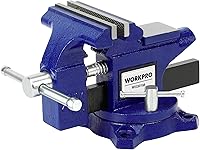
For vise placement and clamping needs, read our workbench with a vise guide. A vise applies force in a specific area, so the overall load number does not answer every mounting question.
Which worktop and finish fit your tasks?
Choose a top that suits the material you work on, and a finish that fits the room. A metal frame does not mean the work surface is metal.
CAMMOO and VEVOR have rubberwood tops, while Pterying uses engineered wood panels. Eltean's worktop material is unspecified, so check it if that detail affects your choice.
A wood surface can suit general assembly and projects where you want a different contact surface from steel. If you expect sparks, heat, oil, adhesives or heavy impacts, check the maker's care and use guidance for the top and frame.
Finishes also differ. Eltean has a powder-coated finish, Pterying is painted and VEVOR has a transparent coating.
The finish label alone does not tell you its resistance to rust, chemicals or scratches, so follow the care instructions and consider your garage conditions.
If choosing a top is part of a DIY build, our plywood vs MDF workbench top comparison explains the main material trade-offs.
How much worktop space and height do you need?
Measure the space your projects occupy and the room around the bench. Width and depth describe the surface, while height affects whether you can work comfortably standing or seated.
The four models offer different footprints and heights:
| Bench | Stated dimensions | Height details |
|---|---|---|
| Eltean 48 in | 24 x 48 in footprint | 65 in overall height |
| CAMMOO 48 x 24 | 48 x 24 in footprint | Adjustable from 36.5 to 48.6 in |
| Pterying 3-Tier | 47.5 x 23.9 in footprint | 61 in overall height |
| VEVOR 72 x 25 | 72 x 25 in footprint | Adjustable from 28 to 39.5 in |
CAMMOO offers 10 height settings, with each level 1.34 in apart. VEVOR also offers 10 manual adjustment positions.
Compare the full range with your work and stool height rather than assuming that every adjustable bench suits every user.
Before buying, mark the bench footprint on the floor. Leave room to stand, open drawers, reach storage and move long boards or equipment around the work area.
How much storage should a metal workbench include?
Choose storage based on what you want within reach and what can stay elsewhere. Drawers, shelves, pegboards and hooks serve different jobs, and more built-in storage can also change the bench footprint.
Eltean combines two drawers, a locking cabinet, a top tray and a pegboard. Pterying has two drawers, three tiers of shelving and a pegboard with 12 hooks.
CAMMOO includes a height-adjustable metal shelf and a pegboard, while VEVOR provides 30 hooks and nail plates on both sides.
For storage you can rearrange, CAMMOO's metal shelf adjusts beneath the tabletop. The workbench accessories guide covers add-ons that can help fill gaps in a simpler setup.
Are built-in lights and outlets useful?
Built-in lights and outlets can reduce the need for separate gear at the bench. Check the outlet count, cable length, light placement and whether those features match your tools.
Pterying has a 14 W LED tube and a power station with four AC outlets and two USB ports. CAMMOO has four AC outlets, two USB-A ports and a 6.5 ft cable, along with a light fixed to its pegboard.
VEVOR's power strip has four AC outlets, two USB ports and a 118 in cable. Its pegboard and 30 hooks can keep tools near the work surface.
Eltean has a magnetically mounted LED light with three color temperatures and adjustable brightness. Its pegboard has four round holes at the back for connecting power.
Follow the maker's instructions when setting up and using built-in outlets and lights.
Which metal workbench should you choose?
Choose Eltean for enclosed storage, CAMMOO for adjustable height in a 48 x 24 in footprint, Pterying for a three-tier layout, or VEVOR for a wider adjustable surface.
Eltean is 48 in wide and includes drawers, a locking cabinet, pegboard and a movable light. CAMMOO has a 48 x 24 in worktop, 10 height settings, a movable pegboard and adjustable under-bench storage.
Pterying adds three shelf tiers, a 12-hook pegboard, LED lighting and a power station in a 47.5 in-wide layout. VEVOR offers a 72 x 25 in surface, 10 height positions, a power strip and rubber casters or adjustable feet.
Pick based on the feature you will use most, then check the load limits, top material, full dimensions and assembly instructions. For other ways to compare garage setups, start with our garage workbench types guide.
What should you confirm before ordering?
Confirm the dimensions, load limits and room conditions before you commit. These checks help prevent a bench from being too large, too tall or unsuitable for the way you plan to work.
- Measure the work area and the route to it, including doorways and turns.
- Check the full height, not just the worktop height, if the bench has a pegboard or light.
- Compare the rated capacity with the tabletop and shelf limits where those are stated.
- Confirm the top material, finish and care directions.
- Check whether assembly requires wall access or extra clearance.
- Check that the outlet and light setup suits your work area.
A metal workbench is a better fit when its frame, top, storage and size match the work you expect to do. Start with the load and footprint, then choose the features that will earn their space.
Frequently asked questions
What should I look for in a metal workbench?
Check the frame material, load rating, worktop material, dimensions, finish and storage. Match the rated load to your tools and work, and check whether the stated rating applies to the whole bench or specific parts.
Measure the footprint and access route before choosing.
Is a steel workbench better than a wood workbench?
A steel frame can suit a buyer who wants a metal structure, while the work surface may still be wood or engineered panels. Compare the full build, including top material, frame supports, rated capacity and finish.
The best fit depends on your work and how you use the surface.
Does powder coating prevent rust?
Powder coating is a finish, but the finish name alone does not tell you how a bench will hold up in your garage. Check the manufacturer's care guidance and keep the surface clean and dry.
For damp or chemical-heavy work, confirm the finish is suited to that environment.
How much weight should a workbench hold?
Choose a capacity above the heaviest load you expect to place on the bench, including tools and workpieces. Check whether the rating covers the entire bench, tabletop, or shelves separately.
A high total rating does not automatically mean every shelf or section can carry that amount.